

316 UCB, 80309-0316
ATLAS Center 329 303-492-7574 303-492-1362

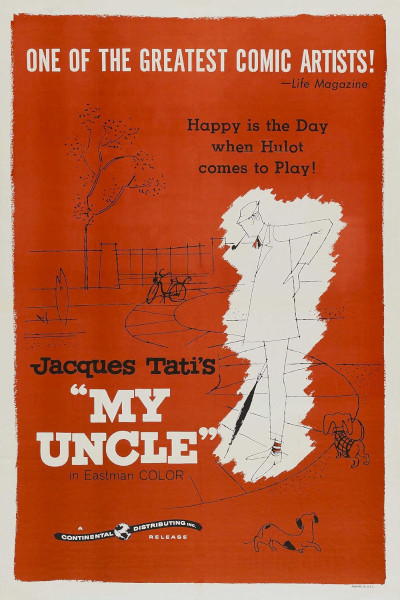
MY UNCLE is the English version of MON ONCLE, which Tati shot simultaneously. He used the same actors, camera set-ups, and would reconstruct the same actions and scenes a second time for this version after the “French version” of the shot was completed. It was an odd exercise considering they are essentially the same films, only with English signs and exaggerated English dubbing from the main actors (strangely, background actors still speak in French).
When you first see Monsieur Hulot, the whimsical wanderer played by Jacques Tati in the classic French comedy MY UNCLE, it takes a moment to realize just how big he is—a two-meter slab of trenchcoat and fedora, his lips perpetually pressed around the stem of a black pipe. He is often seen from the back—a gangly giant observing life’s oddities, curious, perhaps bewildered, but not disapproving. Despite his size and his intense awareness of his environment, he moves with lightfooted grace, personalizing the world around him in a series of small, charming, seemingly offhand gestures. Early in the film, he opens a window in his flat and hears a bird chirp for a split second. Intrigued, he opens and closes the window until he figures out precisely why and when the bird chirps: at a certain point on its axis, the windowpane reflects a beam of sunlight onto the bird’s nest, making it think that morning has come. Pleased by his discovery, Hulot wedges the window in sun-reflective position so that the bird may sing indefinitely.
There is mystery to Hulot, a sense that he lives mostly in his own world, occasionally adjusting the wider world to make it more livable—or at the very least, more reflective of his own eccentric desires. MY UNCLE, arguably Tati’s best and most pleasing movie, is an illustration of the actor-filmmaker’s myopia—a myopia which afflicts everyone in the modern era to some degree, and which Tati brilliantly explored in meticulous physical comedies. The story of a young boy who prefers his absentminded uncle to his rich, acquisitive, gadget-obsessed parents, it presents a world in which characters are defined solely by their actions—actions that are often captured from a distance, in tableaus packed with people, structures, streets and vehicles, all working at cross-purposes yet somehow managing (just barely) to function.
