

316 UCB, 80309-0316
ATLAS Center 329 303-492-7574 303-492-1362

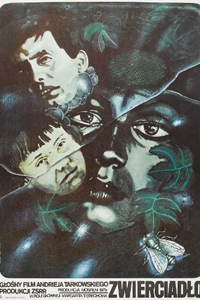
Mirror was the fourth of Tarkovsky’s seven features, and it is his most oneiric and resistant to interpretation. In its prelude, a child on a television screen receives hypnotherapy for his stutter, and his speech becomes fluid; it is as if an oppressive spell has been broken. It’s the kind of mysterious event devoid of explanatory, scene-setting context that happens a lot in Tarkovsky’s films. He believed the world was animated by miraculous energies we have no business trying to explain (least of all to the state lackeys of limited sensitivity and imagination who demanded changes to his scripts). Instances of the uncanny abound in Mirror—acts of physics in motion, independent of humans. A heat mark of vapor evaporates from a tabletop, as nebulous as disembodied breath. A bottle rolls onto the floor, unnoticed, while the eyes of a family are riveted on a burning barn. Déjà vu and a shock of electricity startle a boy picking up fallen coins. These disruptions and shifts in atmosphere are not as unambiguously beyond natural laws as those of Tarkovsky’s movies that tend more toward science fiction—the girl’s telekinetic, glass-moving stare in Stalker (1979), for instance—but they alert us to the fact that this is a world that is not inert. It teems with elemental forces. Rain falls, fires blaze, and winds rise in Mirror, as a restless camera glides with what seems a life of its own, unmoored from the perspective of any human gaze, and animating material reality with its attention.
The planes of art and reality, memory and dream, are not clearly defined in Mirror, which holds all as equally vivid within the mind and cosmos. To this end, it freely blends black-and-white newsreel footage with luminous, slow-motion dream sequences, emotionally charged reminiscences, and even the reproduction or restaging of early modern European paintings. Alexei’s anecdotal recollection of a snowy day during the war prompts a visual echo of the composition of Pieter Brueghel’s The Hunters in the Snow. The same painting hangs in the space-station library in Solaris (1972)—amid that film’s strangely sentient environment and apparitions of the dead—the artwork’s harmonious landscape of winter activity reifying a yearning for home on Earth, in the cycle of nature, as the camera takes in its details. Art reminds us who we are, and promises nothing less than a transcendence of mortality—at least for lost voyagers.
Tarkovsky wrote in his diary that Mirror confirmed for him the “importance of personally experienced emotion” and “the author’s intimate truth” to making cinema that is able to convince audiences.
— Carmen Gray, The Criterion CollectionSun September 21, 2025, 2:00 PM, Muenzinger Auditorium
Soviet Union, 1975, Russian*/Spanish*, B&W/Color, 108 min, 1.37:1, NR
