

316 UCB, 80309-0316
ATLAS Center 329 303-492-7574 303-492-1362

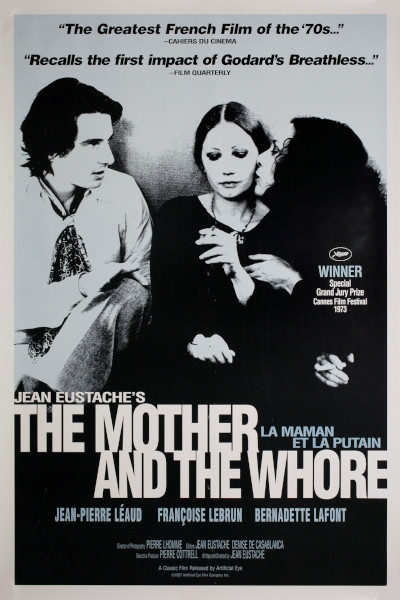
When Jean Eustache's "The Mother and the Whore" was released in 1973, young audiences all over the world embraced its layabout hero and his endless conversations with the woman he lived with, the woman he was dating, the woman who rejected him and various other women encountered in the cafes of Paris. The character was played by Jean-Pierre Leaud, star of "The 400 Blows" and two other autobiographical films by Francois Truffaut. In 1977, Truffaut made "The Man Who Loved Women." This one could have been titled "The Man Who Loved to Hear Himself Talk." At 3 1/2 hours, the film is long, but its essence is to be long: Make it any shorter and it would have a plot and an outcome, when in fact Eustache simply wants to record an existence. Alexandre (Leaud), his hero, lives with Marie (Bernadette Lafont), a boutique owner who apparently supports him; one would say he was between jobs if there were any sense that he'd ever had one. He meets a blind date named Veronika (Francoise Lebrun) in a cafe and subjects her to a great many of his thoughts and would-be thoughts. (Much of Lebrun's screen time consists of closeups of her listening.) In the middle of his monologues, Alexandre has a way of letting his eyes follow the progress of other women through his field of view.
The first time I saw "The Mother and the Whore," I thought it was about Alexandre. After a viewing of the newly restored 35-mm. print being released for the movie's 25th anniversary, I think it is just as much about the women, and about the way that women can let a man talk endlessly about himself while they regard him like a specimen of aberrant behavior. Women keep a man like Alexandre around, I suspect, out of curiosity about what new idiocy he will next exhibit.
"The Mother and the Whore" made an enormous impact when it was released. It still works a quarter-century later because it was so focused on its subjects, and lacking in pretension. It is rigorously observant, the portrait of an immature man and two women who humor him for a while, paying the price that entails. Eustache committed suicide at 43, in 1981, after making about a dozen films, of which this is by far the best known. He said his film was intended as "the description of a normal course of events without the shortcuts of dramatization," and described Alexander as a collector of "rare moments" that occupy his otherwise idle time. As a record of a kind of everyday Parisian life, the film is superb. We think of the cafes of Paris as hotbeds of fiery philosophical debate, but more often, I imagine, they are just like this: people talking, flirting, posing, drinking, smoking, telling the truth and lying, while waiting to see if real life will ever begin.
— Roger Ebert, rogerebert.comSun April 21, 2024, 2:00 PM, Muenzinger Auditorium
France, 1973, in French, 219 min
Director: Jean Eustache, Writer: Jean Eustache, Cast: Bernadette Lafont, Jean-Pierre Léaud, Françoise Lebrun, Isabelle Weingarten, Jacques Renard
